Monday, November 16, 2015

Driving Range Tee Improvements

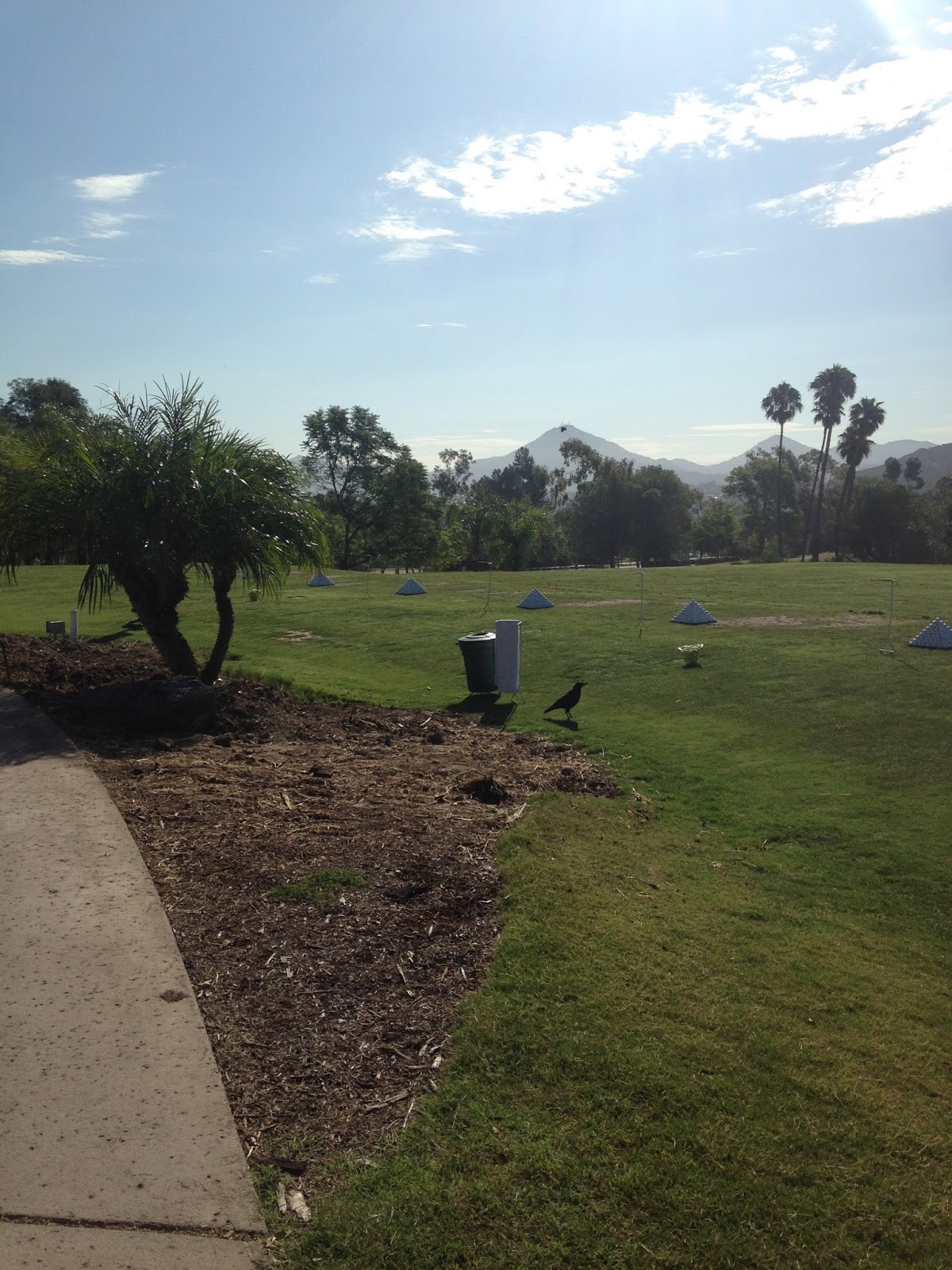
The back tier of the driving range tee has been shrinking for years.  The usable practice area was limited by a landscaped bed at the back of the tee, costing us nearly a week of playable turf.  In early August, we removed the palms in that bed and started to prepare the tee for new sod.

The Tifway hybrid bermuda has been down for over a month and players have enjoyed the tee for the last two weeks.  Playable surface area increased from 4700 square feet to 7400 square feet, a 60% increase.  We should get three weeks of practice time on the upper tee alone.

Further improvements to the area include the renovation of the space between the driving range and the tee complex for the first hole.  We removed some large and overgrown birds of paradise bushes and will be planting over fifty drought tolerant plants matching the rest of our new landscape. Decomposed granite will replace the turf that used to cover this area, providing a clean look and multiple access points between practice area and the first tee.

This small project increases our turf reduction total by another 3500 square feet to nearly 40 acres in the last three years.

Tuesday, September 1, 2015

New Tool, New Toy

I recently submitted a video to a contest hosted by TurfNet and Aquatrols on the topic of Smart Water Management.  Our Turf Reduction Program offered some great material and saving water has been our focus for a number of years.  Doug Ayers of Corral de Tierra, one of the most innovative superintendents I've ever known, took first place leaving me with a very cool second place prize.  You can see the top three videos by following this link: TurfNet Videos

We now have a tool in our arsenal that does much more than entertain, which it does quite well.  The DJI Phantom 3 Advanced drone is the most exciting toy I've ever owned.  It reaches speeds over 30 mph, comes with a very good camera, and can capture photos and videos I've always wanted at a golf course.

So, how is this useful to the course?  First off, the obvious answer is the marketing potential, shooting excellent photos at no additional cost.  Aerial photographs have always been attractive to a golf course, but the price tag made it hard to justify.  You'll be seeing many new photos on the website, blog, and newsletter as I pick out the best and share with the other departments.

From a turf standpoint, the overhead view is very useful to investigate problems that are hard to see at ground level.  Drainage issues, irrigation uniformity, soil inefficiencies, fertilizer applications, and shade patterns are just some of the issues we face everyday.  A quick flyover by the drone will produce many photos I can share with our staff as we work to make the course as good as it can be.

Project planning and documentation are also made easy with wide angle pics achieved with altitude.  Before I would draw out plans on the shop's dry erase board and point to old maps in the shop along with a trip to the job site.  Having a actually photo of the area in question with sketches right on the photo takes out any guess work and allows the staff to accomplish exactly what I'm looking for without extra supervision.

  Last night, I was trying to get some sunset photos on the par 3 12th hole.  The sunset was a little disappointing with much of the color lost in a distant marine layer.

I'm still learning to fly the drone, but I can't help to get a little overconfident and fly too close to potential hazards, for example, the the ash tree next to 12 green.  The video of the crash is great, but the blogger site is not liking it right now.  I'll try again later.

The good news is the drone is OK and was back in the sky after I dusted off the leaf debris and bunker sand.

In case you were wondering, my dog, Izzo, hates the drone.  When she is around, I have to land it on top of a golf cart.  I'll post a good example in the near future.


Friday, August 7, 2015

Things you'll see this weekend

Each weekend, members are treated to the first look of some new scenery.  Closing the back nine during the week allows our contractors and the BHCC staff to accomplish so much more while remaining safe from errant shots.  We appreciate your patience and understanding during this very important project.

 In 3 weeks, United GLI has finished holes 12, 13, 14, and 15 and the 16th hole is being planted today. All turf to be removed is stripped off number 17 which will be irrigated with drip emitters next week.  The tee complexes on #'s 11, and 18 are also ready for new plantings and then it's on to holes 10 and 11.

If you haven't been to the club recently, there are changes to be seen from the moment you pull up the driveway.  For 3 years, I've wanted to remove the grass that struggled under the ficus trees and dress up our entry with drought tolerant plants that look good year round.  I'm pretty happy with the new look as are many of the club's visitors.


The driving range is missing a few plants that divided the pavement from the back tee.  We are transplanting the palms and ornamental garlic to make room for more tee space.  The back tee of the range will be renovated in-house over the next month and this is step number one.  We should gain about 5 days worth of practice, all of which will be on level bermudagrass.

The fairway on #13 has finally been sprayed out with Monument herbicide which eliminates cool season grass, leaving only bermuda behind.  This is the last fairway, besides some of the par 3's.  I'm pretty happy with the amount of bermuda that we have to work with.  Most areas will fill in the small voids and we will sod any large sections.  As intended, we will have 100% bermuda fairways by the end of this summer, 3 years after beginning this campaign and 5 years post-overseeding.

New turf on a reshaped, combo tee for #'s 11 and 18 looks a little brown, but don't worry.  Bermuda sod will often turn brown if it becomes stressed out as a defense mechanism to limit carbohydrate reserves until there are better conditions.  As you can see, there are many new white roots already 3 inches into the soil.  This sod will be solid green in no time.


Tuesday, July 21, 2015

Rain in July

This past weekend, the course accumulated 1.4 inches of rain over 48 hours, most of it came down in 5 hours with heavy downpours.  I came to the course early Sunday morning expecting the worst in our new mulched and sanded turf removal zones.  I knew the mulch would be fine, it always is.  The steepest, mulched portion is around the tee box on the fourth hole which suffered no erosion at all.

I was relieved to find that most sections of the sand held up very well like this portion of number 3 (below), there was no cleanup needed.


Portions of sand that did erode highlighted the need for drainage improvements.  In the photo below and left is the area between the tee and fairway on the third hole.  This tracking was a result of a plugged cart path drain that sent water across the sands.  Cleaning up of this area took about 20 minutes using a mechanical rake, so it was a quick fix.

A more troubling problem was along the path by the fifth hole where sands were eroded badly.  We have reviewed this area and will install some new drainage to divert the flow of water.  This rain was a wonderful test of our new design.  Problem areas were identified, stability was tested, and cleanup efforts were put through a trial run.


Of course, the best part of this unexpected rain was the impact to our turf.  The rough, fairways, tees, and trees received the most uniform irrigation in months.  Our out-dated irrigation system and even the newest irrigation system is a poor substitute for real rain.  Also, rain is not heavily polluted by salts, so the flushing power can clean out the garbage that's piled up in our soils.  The putting greens looked refreshed on Sunday and our handheld EC meter, which records salinity content, was proof that the rain worked wonders.


Wednesday, June 24, 2015

First Hole is Complete

A month after this project began, we have the first hole finished.  The par-4 Fifth hole is now completely landscaped with over 1000 new plants.  All the turf surrounding the tees has been removed and replaced with sand.  Border areas and slopes on both sides of the hole have been dressed with 3-4 inches of dark brown mulch.  There's a new path around the back tee that leads to the restroom, a often requested addition using more compacted sand in an area which used to be water-loving grass.  This project is moving along nicely and it feels good to have an area complete.

The crews spreading mulch and sand are now busy on the sixth hole and soon will head to #4 where irrigation is ready and planting is nearly finished.  Ahead of the planting crew are irrigation installers and ahead of them are a handful of guys running trenches for the hard pipe portion of the drip line.

The project is on track to complete holes 3 thru 8 in the second week of July.  We will then move on to the back nine for approximately six weeks.


You may notice some dried out sections and some traffic zones that have turned brown during this project.  This is an expected result of a construction project and these areas will recover very quickly.  A little water, fertilizer, and some venting with an aerifier can get bermuda to green up and bounce back.

When you get to play these completed holes this coming weekend, we'd like you to keep your carts out of the new areas as much as possible.  There are a couple zones where carts can cross through the sands to get to the fairway, so feel free to do so.  However, if your ball lands in the mulch, please walk to that location and leave the carts behind.

More updates coming soon.

Thursday, June 11, 2015

Nearing a finished product (on one hole)

Number five is where this process started and that hole will be the first to be completed.  We are actually pretty close, just a few weeks since the project began.  All the old turf has been removed, the soil has been rototilled and then compacted, flags have been placed to designate locations of plant material and now the crew is installing irrigation.

The drip system uses sub service delivery in 3/4 inch pipe.  The only part that comes above ground is the emitter to water each plant.  Trees will get soaker hoses in a couple of rings, but besides that, we will not have any hoses above ground.  This allows us to use a bunker rake to dress up the area periodically without damaging any drip line.  Also, players will not encounter drip lines when playing out of the native zones.


There are many hundreds of feet of drip line trenches on each hole.  This is a pretty time consuming task, but with 4 trenchers going at once, it's moving faster than I had expected. Once the irrigation is installed, the plants will go in and the compacted sands and mulch will be spread as a final piece.  The sand will be compacted with hand and mechanical rollers and the area will be finished.  

The first shipment of plant material came in today, mostly larger items like 36" box sycamore trees, 24" box pink malaleucas, and some 15 gallon 'after dark' peppermint tree.  It's going to look pretty sharp out there.  


Monday, June 8, 2015

Update and artist rendering

Below, is a representation of our finished product.  One of the priorities of our plant selections was to bring some color into our landscape.  This isn't an official plant map, so don't be too concerned about the specifics.  More than likely, we will have thinner plantings between tee and fairway, heavier plantings as you move towards the OB lines and homes.  


Baccharis pilularis, called Coyote Brush

Notice the contrast provided by the grass against the compacted sands bordering the mulch on the slopes.  Within the mulch areas are thick ground covers like acacia and baccharis pilularis, or coyote brush.  We are considering 22 different plants to be used in the plan including a variety of trees, bushes, ground covers, and grasses.  I will share the complete list when we've confirmed availability of all plant types.  As you may suspect, getting drought tolerant plants is fairly difficult with all these projects occurring at the same time.


Today, some flags are being placed on hole number 5, to mark plant locations and the dividing line between mulch and sand.  Turf removal on holes 4 thru 8 will be completed in the next couple of days and soon we will be digging up heads on the rest of the course which was sprayed with herbicide one week ago.  You can already see the effects of the treatment on this large portion of turf between the 9th tee, 2nd fairway, and the driving range.  This is a great example of useless turf that will be replaced by much more attractive low-water plantings.
Finally, last week BHCC hosted the Women's Member-Guest Tournament in the middle of a very messy project.  Instead of complaining about the dust and less than perfect conditions, our members used the opportunity to showcase our efforts to reduce water usage and beautify the club.  The staff and I received so much praise for our work in making the course as presentable as possible.  Of course, everything was mowed, the bunkers were raked, detail areas trimmed, and the greens cut and rolled.  However, the unusual work was plentiful, like a new walk path to the 3rd tee box.  It had been rototilled the day before to a depth of 8 inches and walking to the tee box would have been very difficult.  We shoveled up the mess, lined the path with some shredded bark, and marked the entrance with some cobble stone.  

In just a few weeks, the entrance to this tee box will take on another design... attractive, permanent, and drought tolerant.